

Confirm the diagnosis
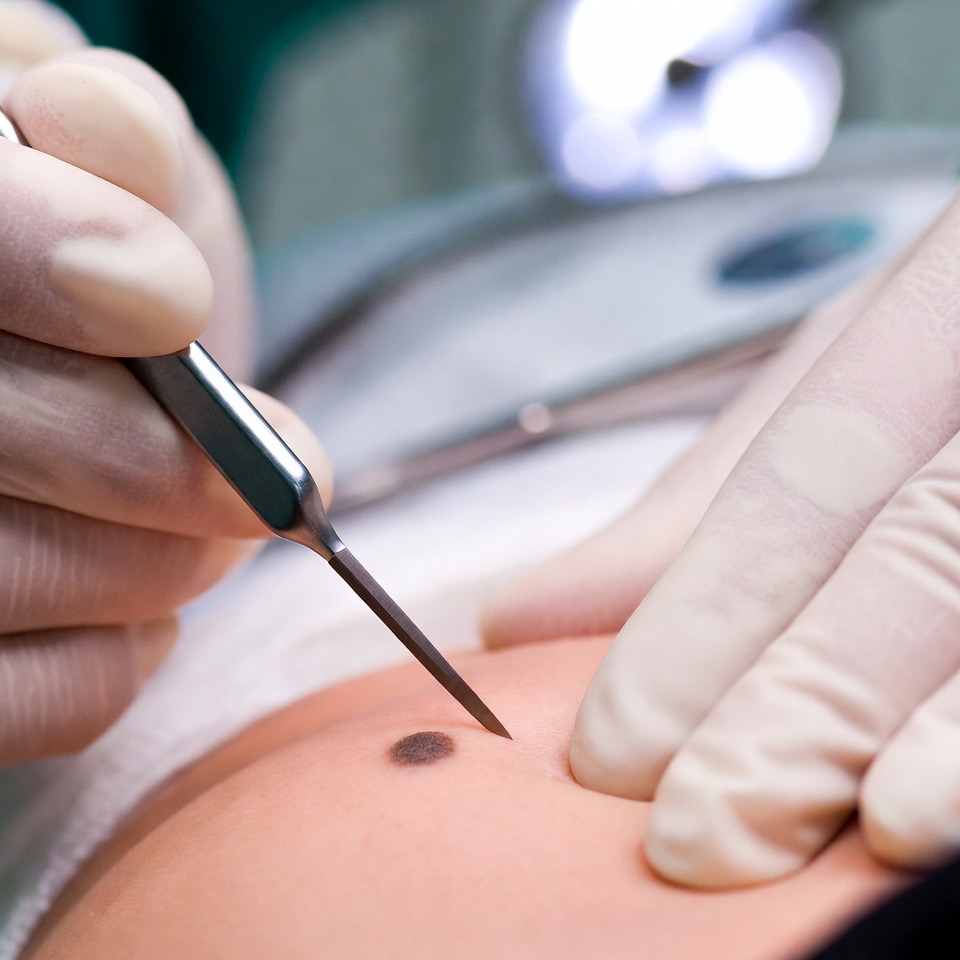
A targeted diagnostic biopsy provides the basis for final treatment planning.
Dermatological surgery · Skin tumour surgery
In many cases we can treat even challenging skin cancers entirely as an outpatient – from the first diagnostic biopsy to histologically controlled removal and an aesthetically planned wound closure.

Our standard
Skin cancer surgery means more than cutting out a lesion. Tumour type, safety margin, body area, function and the later appearance of the scar must be planned together.
A targeted diagnostic biopsy provides the basis for final treatment planning.
The excision is planned to match tumour type, size, depth and anatomical location.
On the face in particular, we choose the wound closure with an eye on contours, tension and the course of the scar.
The treatment pathway
With a lesion suspicious of skin cancer, the final operation does not follow blindly but on the basis of a confirmed microscopic diagnosis.
We examine the skin lesion clinically and dermoscopically and decide which form of tissue sampling makes diagnostic sense.
Under local anaesthesia, a representative piece of tissue is taken and sent to a specialised dermatopathology laboratory.
The histological findings determine which safety margin, surgical technique and further diagnostics are needed.
The confirmed tumour is excised with the medically required margin. The later closure is already considered when planning the incision.
The entire surgical specimen is examined microscopically again. If a margin is not tumour-free, a targeted re-excision follows.
Outpatient skin tumour surgery
We perform most procedures in our fully equipped operating area under local anaesthesia. As a rule, you can leave the practice afterwards.
What is often possible as an outpatient
Reconstruction on the face
On the nose, eyelid, lip or cheek, direct wound closure can lead to tension, distortion or an unfavourable scar. A local flap uses well-perfused skin from the immediate surroundings and moves it so that function, contour and skin texture are preserved as well as possible.
1 Defect after complete excision
2 Neighbouring skin is mobilised
3 Shape-appropriate, low-tension closure
Histopathological safety
Every specimen excised during skin cancer surgery is sent to our specialised dermatopathology laboratory. There, tumour type, extent and margins are assessed.
After the surgery
We accompany not only the procedure but also the histological result, wound healing and further dermatological check-ups.
Early check of blood supply, wound edges and healing – especially after flap reconstructions.
The timing depends on the body site, closure technique and individual wound healing.
Sun protection, tapes, silicone and, if needed, later laser treatment are discussed individually.
Check-up intervals are adapted to tumour type, risk profile and your personal skin findings.
Good to know
The exact treatment pathway always depends on the histological tumour type and anatomical location. These answers give a first orientation.
The small tissue sample clarifies whether skin cancer is actually present and what type of tumour it is. Only with this information can the safety margin, extent of surgery and any reconstructive closure be planned reliably.
Yes. Many basal cell carcinomas, squamous cell carcinomas and early suspected or confirmed melanomas can be treated entirely as an outpatient under local anaesthesia. Tumour type, size, depth, location and possible associated conditions are decisive.
The excised tissue is examined histopathologically. If the assessment shows tumour cells at a margin, we plan a targeted re-excision until a medically safe result is achieved.
Well-perfused skin from the immediate surroundings is moved or rotated to close a defect with little tension. On the nose, eyelid, lip or cheek in particular, shape and function can be preserved better this way than by simply pulling the wound edges together.
For very extensive or particularly aggressive tumours, when general anaesthesia, lymph node diagnostics or interdisciplinary care is needed, we specifically recommend a specialised hospital. We make this decision transparently on the basis of the histological findings and your overall situation.
SkinBerlin · Berlin-Schöneberg
Book an appointment for a specialist assessment or to plan the next steps after an existing skin cancer diagnosis.